Data Privacy
ITA-Maskit
A local audit-data workbench combining hybrid detection, human review, original-page PDF redaction, and an optional C++ acceleration core.
- Project scope
- CLI + Windows desktop app
- Current status
- Completed
- My role
- Independent developer
Technology
- Python
- Polars
- PyQt5
- C++
- Tesseract
- Deterministic pseudonymization
What it solves
Audit material often combines tables, JSON, email, PDF, and Word, where manual processing can miss sensitive values and break the relationship between the same person or employee identifier across files. ITA-Maskit connects rule selection, hit preview, local processing, and versioned audit records so that necessary joins survive while source values leave the original files.
Core capabilities
- Select rules and batch-process files through the CLI or Windows GUI
- Process tables, JSON, email, PDF, and Word locally
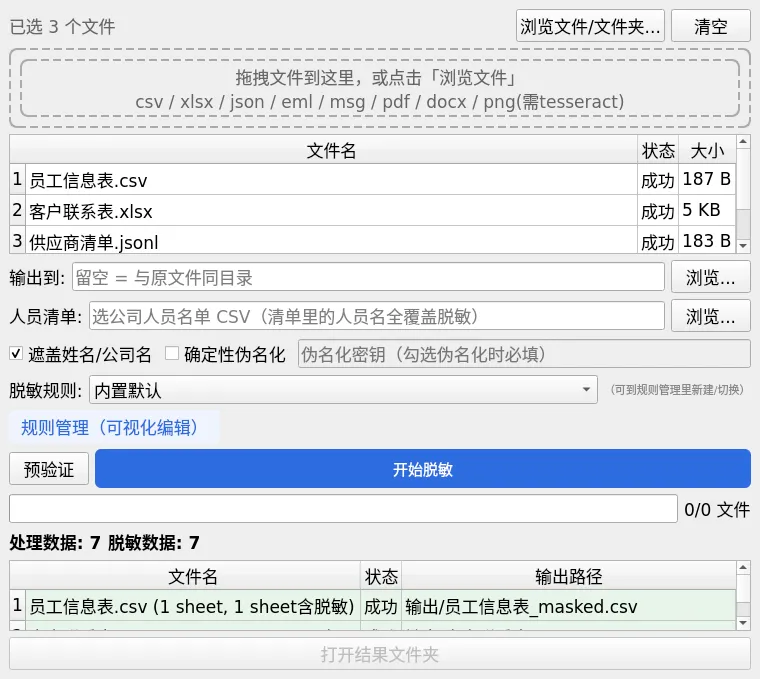
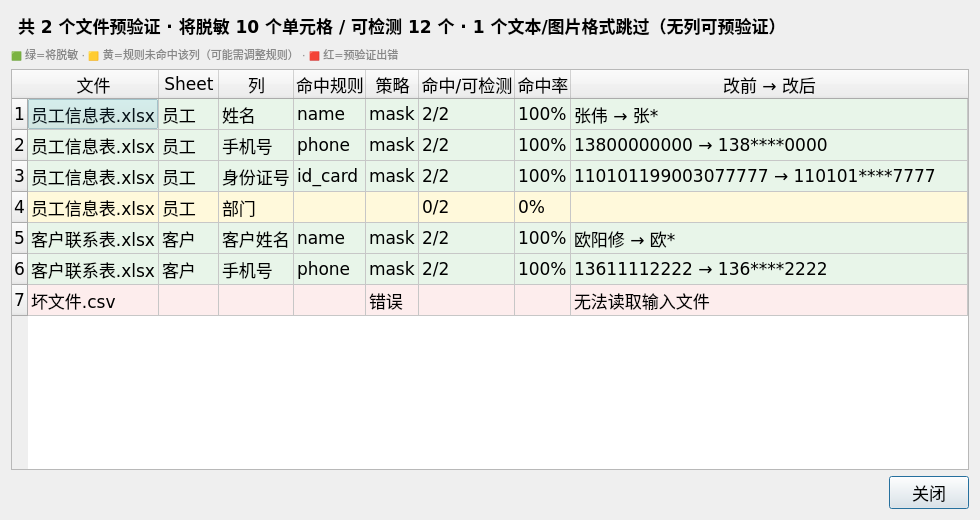
- Preview rule matches and sample changes before writing output
- Choose masking or deterministic pseudonymization
- Use personnel lists to improve name and employee-ID matching
- Inspect statistics, output locations, and versioned audit logs
How it works
- Select files, a rule set, and optional personnel data
- Preview matches without writing output
- Execute masking or deterministic pseudonymization locally
- Inspect statistics, output paths, and the audit log
Users select files, rule sets, and personnel lists through the CLI or Windows GUI. The workbench previews rule matches and sample changes before it writes anything, then processes the batch locally; statistics, output locations, and versioned audit logs stay within the same processing boundary.
Project highlights
Cover tables and documents with two processing engines
The table engine processes CSV, Excel, and JSON/JSONL by column; the document engine handles email, PDF, and Word. Detection combines column matching, strong-feature checks on whole cells, and inline or full-text scanning. Weaker signals such as phone numbers and employee IDs require configuration or context to reduce accidental masking of ordinary numbers.
The August update adds original-page PDF redaction: digital pages use text geometry and scanned pages use local Tesseract OCR. Pages retain their dimensions and are rescanned; output is removed if detected source text remains recognizable. Image-crop masking remains a separate beta feature rather than the processing path for scanned PDFs.
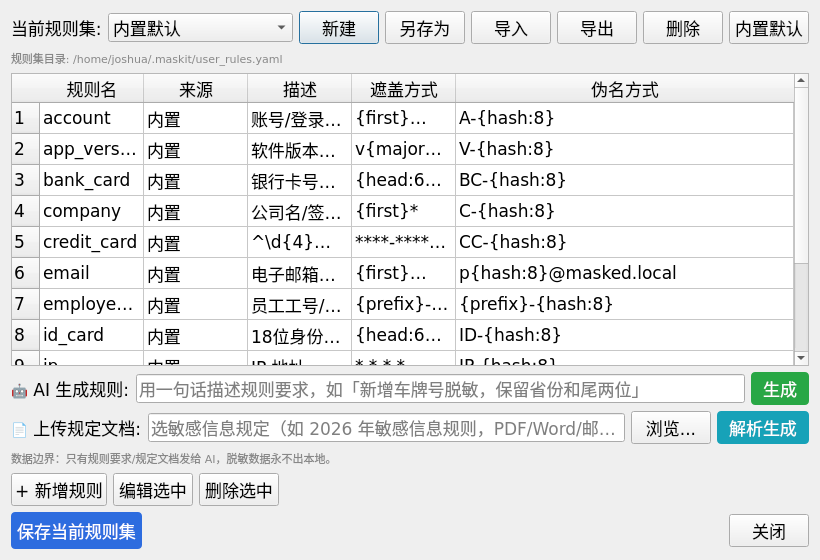
Turn masking policy into maintainable data
YAML stores field mappings, match strategies, masking templates, and pseudonymization templates while rule versions remain separate from processing code. A business-policy change updates validated data configuration; preview and formal execution reuse that same version to reduce rule drift.
Failed identity or bank-card checksum checks can enter human review. Strict mode leaves no final output while review items remain unresolved; review records contain fingerprints and masked previews by default. Optional LLM rule generation sends only the supplied policy description or policy document, never the files being masked.
Preserve cross-file joins without exposing source values
Inputs are normalized according to field strategy before a user-supplied pepper participates in domain-separated HMAC. The same normalized value therefore receives a stable deterministic alias across files, while personnel lists can improve name and employee-ID matching; source values are not exposed as aliases, and the pepper remains runtime configuration.
An optional C++ core accelerates HMAC, personnel-list Trie matching, and checksums, while the full Python path remains available. Repository figures of roughly 3× for HMAC and 26× for Trie matching describe kernel benchmarks rather than whole-table speedups. F1=1.0 on synthetic gold/stress fixtures does not establish zero misses on real audit material.
System architecture
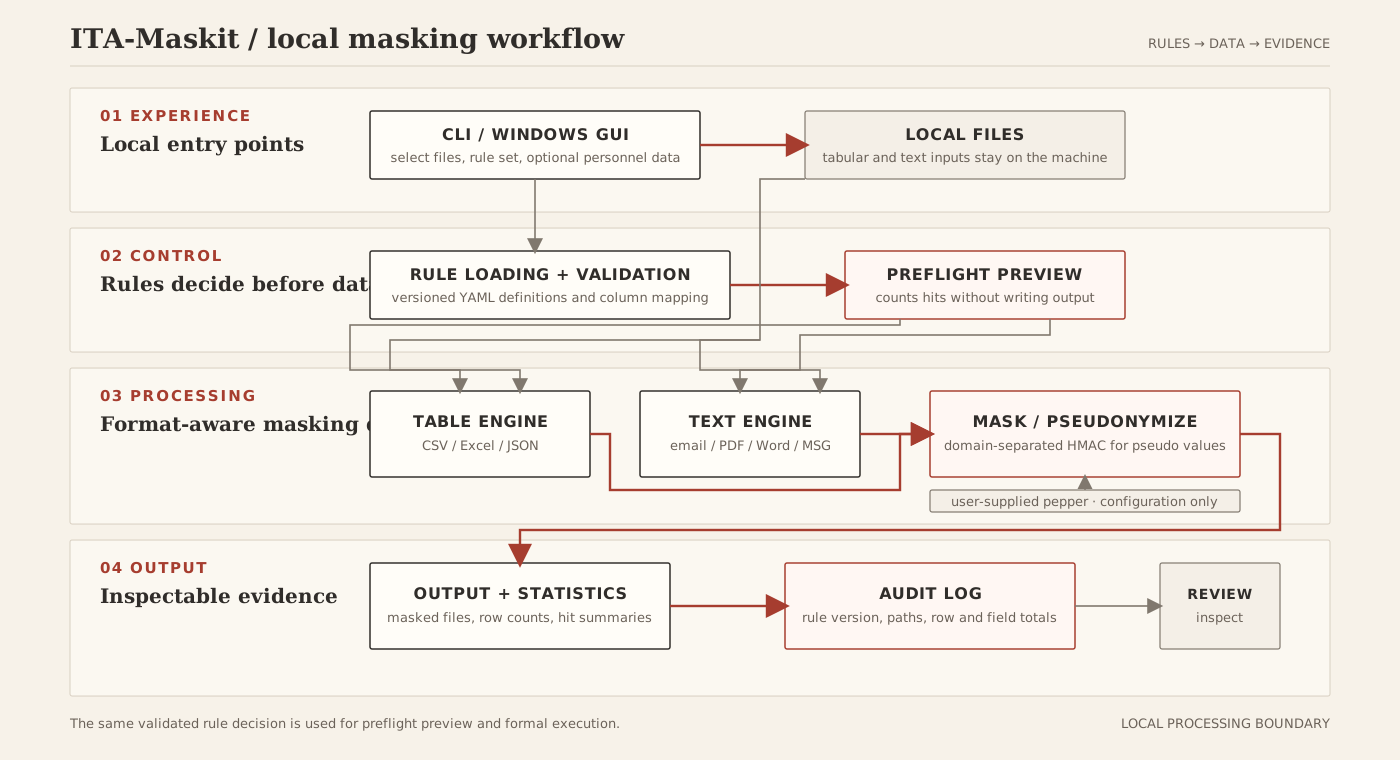
The same rule version drives preview first, then routes files through the column-based table engine or full-text document engine. Masking or deterministic pseudonymization produces the output, statistics, and versioned audit log locally, without sending audit material to an external service.
Project scope
This is a local audit-material processing tool, not a claim of certification or a replacement for deployment-level access control, key management, or encrypted storage; screenshots use scripted demonstration data from the repository. Deterministic pseudonymization is not encryption. Image cropping remains beta; PDF rescanning checks detected source text and cannot prove that a complete document contains no sensitive information. Scanned pages require local OCR, and PyMuPDF licensing needs a separate distribution review.